From Izeaux to Saint-Jean-de-Moirans
Rémy-Alexis Richard was born in 1878 to a farming family in Izeaux. He started as a cutter, then went to Paris with his own designs and sold them as a factory agent. In 1910 he married Juliette Pontvert and founded Richard-Pontvert.
A trip to the United States in 1926 changed the direction of the business. He saw rubber boots and came home with latex expertise. He registered the name Paraboot in 1927: "Para" for the Amazonian port that exported latex, "boot" for the American shoe. Four generations on, all production is under one roof in Saint-Jean-de-Moirans.
Design philosophy
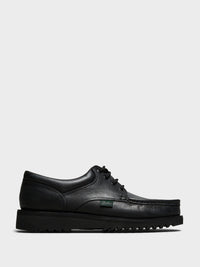
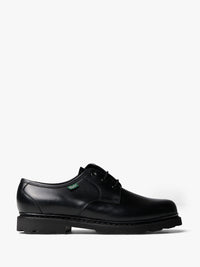
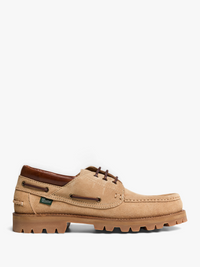
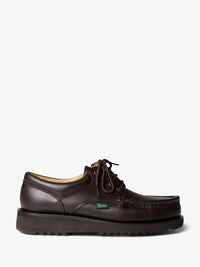
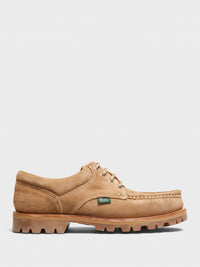
Paraboot works from a simple principle: the shoe adapts to the foot, never the reverse. The look that follows is easy to recognize. Soft, almost matte leather sits on a thick, hard-wearing rubber sole, often in a moc-toe silhouette.
The positioning is high-end, yet it rejects the ostentatious side of luxury. The soles are cast in the brand's own workshops from natural latex. Much of the leather is tanned in France by tanneries the company has worked with for generations.
Norwegian welt and French craft
After the war, rivals switched to plastic soles glued to lighter uppers. Paraboot kept sewing. Norwegian and Goodyear welts, with the stitching running along the outer edge, make the soles replaceable, and many steps are still done by hand.
Because of the welt, a worn sole can be replaced instead of the whole shoe being discarded. The approach has earned the French state's Entreprise du Patrimoine Vivant distinction.
Paraboot Michael and signature models
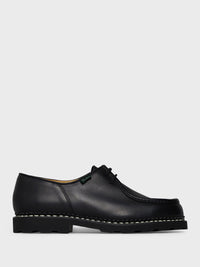
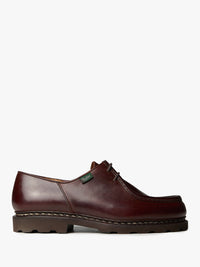
Julien Richard released the Michael in 1945. It is a hand-sewn derby with a moccasin-style calfskin upper and a rubber sole. In the 1980s Italian fashion stylists chose it for the new tweed and corduroy look, and the orders that followed helped save the company. The Michael remains its poster shoe.
Around it sits a wider range, from Alpine boot roots to more elegant derbies. The Avoriaz and Yosemite boots carry the mountain heritage. The Clusaz, Thiers, Barth, and Santorin shoes offer more relaxed styles, with Michael and Santorin also made in women's versions.
Collaborations and standing in fashion
Paraboot has worked with Engineered Garments, including the EG Clusaz, as well as The North Face, Kaptain Sunshine, and Aimé Leon Dore. It also released a collection with Patou. Esquire and Robb Report have written about a cult brand loved by farmers and street-style followers alike. Exports make up around half of sales. See also accessories and sandals.
Frequently asked questions
Is Paraboot a French brand?
Yes. Paraboot is based in Saint-Jean-de-Moirans in the Isère region, where all its production now takes place. It remains one of the last emblems of sewn, Made-in-France shoemaking.
Why is Paraboot so expensive?
The shoes are sewn rather than glued, with Norwegian or Goodyear welts and many manual steps. The rubber soles are cast in the brand's own workshops, and much of the leather is tanned in France. The result is a shoe you can resole.
Are Paraboots high quality?
Yes. The brand keeps to sewn construction and long-standing tannery partners. It has also received the Entreprise du Patrimoine Vivant distinction from the French state.
Is Paraboot a luxury brand?
Its prices are high, but it avoids showy luxury. The collections follow traditional shoemaking rules and use fine materials, with an urban feel.
What is Paraboot best known for?
The Michael derby, launched in 1945, with its soft leather upper and thick rubber sole. It became a staple of the tweed and corduroy look in the 1980s and is still the brand's best-known model.