Brand Origins
Arc'teryx was founded in 1989 by a group of climbers from Vancouver. The company began by producing high-quality climbing harnesses and backpacks, with a clear ambition from the outset: to build equipment that holds up even when conditions are at their most demanding. The brand takes its name from Archaeopteryx, the first bird to evolve from dinosaurs, a symbol of an evolutionary leap forward in design and function.
Headquarters remain in Vancouver, with the Coast Mountains serving as a natural extension of the development process. This rugged terrain in the Canada Coast Mountains, spanning over 336,000 km², sits just an hour's drive away and functions as the brand's permanent testing ground. The proximity to extreme weather conditions is not incidental; it is the foundation of Arc'teryx's entire approach to technical clothing and outdoor gear.
Precision and Construction
The pursuit of precision is an iterative process. Arc'teryx maintains this standard through a culture of constant prototyping. By keeping the design process close to production, the brand achieves a level of detail rarely seen in mass-produced clothing. This includes heat-mapped insulation that places warmth exactly where the body needs it most, and articulated joints engineered to move with the body rather than against it.
The result is clothing that does not work against the wearer. Freedom of movement in the field is not a compromise but a design requirement, and every gram in the construction is a deliberate choice. It is a disciplined approach driven by obsessive design, where every stitch is considered and every detail justified to elevate product performance.
Product Name Abbreviations
Arc'teryx uses two-letter codes in its product names to indicate intended use. The system provides an immediate overview of the activity type and weather conditions each product is designed for:
SL – SuperLight: Focused on low weight and a compact pack size.
FL – Fast & Light: For minimalists in high-output activity, where every gram counts.
LT – LightweighT: Balances low weight with durability, suited to a wide range of activities.
AR – All-Round: Versatile across many activities and changing conditions, a classic within the category.
SV – SeVere: For the harshest mountain conditions in the strongest materials, intended for extreme expedition use.
MX – Mixed weather: Prioritises breathability and mobility in variable weather.
IS – InSulated: For maximum insulation and thermal protection.
Our selection at Stoy spans technical shell jackets and fleece layers through to accessories such as warm outdoor gloves and our range of functional backpacks.
Materials and Technology
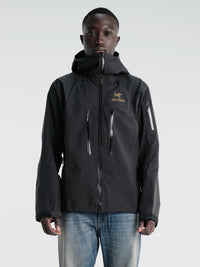
Arc'teryx primarily uses nylon as the face fabric in hardshell jackets, combining durability with low weight. Advanced laminates in a three-layer construction deliver superior weather protection for technical waterproof jackets alongside reliable breathability. The balance between these two properties is central to technical clothing, where both perspiration and weather are constant factors.
Arc'teryx invented the waterproof zip, which eliminates the need for storm flaps and reduces overall weight. A DWR (Durable Water Repellent) treatment ensures that water beads off the surface rather than saturating the face fabric.
Fit and Freedom of Movement
Arc'teryx's ergonomic approach means that jackets and layers are cut to follow the body's natural movement patterns. Pre-shaped sleeves prevent the arms from riding up when raised, and adjustable hoods are constructed so they do not obstruct vision, ensuring uncompromised functionality during active use. Articulated joints and precision patterning provide complete freedom of movement, even when wearing a heavy pack or climbing harness.
The design is minimal and clean in its silhouette, which makes these pieces easy to wear in the city as well as in the mountains. Arc'teryx jackets for men and women perform in both settings: as a waterproof jacket on a grey city day and as a ski jacket on the slopes. The same logic applies to layering, where a technical fleece worn as a mid-layer complements the shell rather than competing with it. See also our functional jackets for all weather for inspiration on building your own system.
Authorised Retailer
Authentic Arc'teryx products carry the brand's distinctive Archaeopteryx logo and clear quality markings. Counterfeits are widespread in the secondary market, and purchasing from an authorised retailer removes that risk entirely.
Shopping with an authorised retailer also provides access to proper warranty handling and product guidance. Stoy is your authorised Arc'teryx retailer in Denmark, including Copenhagen, whether you are looking for a shell jacket for women, a ski jacket for men, a winter jacket for women, or a pair of Arc'teryx rain trousers. If you have questions about our selection, feel free to contact us at help@stoy.com or +45 41 95 54 44 during our customer service hours.
Proper care significantly extends the life of the DWR treatment and keeps the membrane intact season after season. Arc'teryx recommends washing with a mild technical detergent formulated for performance clothing. Avoid fabric softeners, as they break down the DWR treatment. Tumble drying on a low heat setting reactivates the water repellency. Avoid steam on seam-taped or bonded constructions, as high heat can weaken the adhesive and cause delamination. Re-proofing the jacket regularly will maintain its waterproof properties over time.
Arc'teryx FAQ
Who sells Arc'teryx in Denmark?
Arc'teryx is sold in Denmark through a selection of authorised retailers, including Stoy, a premium retailer with stores in Copenhagen and Aarhus. We recommend purchasing from authorised retailers to ensure product authenticity and access to proper warranty and service.
What do the abbreviations in Arc'teryx product names mean?
The letter combinations in Arc'teryx product names indicate at a glance which activity and weather conditions the jacket is designed for: SL = SuperLight (low weight, compact pack size), FL = Fast & Light (for minimalists in high-output activity), LT = LightweighT (lightweight and relatively durable), AR = All-Round (versatile across many activities), SV = SeVere (for the harshest mountain conditions), MX = Mixed weather (breathability and mobility in variable conditions), and IS = InSulated (focused on insulation and thermal protection).
How do I wash my Arc'teryx jacket correctly?
Arc'teryx recommends washing with a mild technical detergent formulated for performance clothing. Avoid fabric softeners, as they break down the DWR (Durable Water Repellent) treatment that causes water to bead off the surface. Tumble drying on a low heat setting can reactivate the water repellency. Avoid steam on jackets with bonded or seam-taped constructions, as high heat can weaken the adhesive and cause delamination. Re-proofing the jacket regularly will maintain its waterproof properties.
Are Arc'teryx jackets only for outdoor use, or can they be worn in the city?
Arc'teryx jackets are designed to perform in both environments, blending technical innovation with clean, modern aesthetics. The brand's minimal aesthetic and clean silhouettes make them straightforward to integrate into an urban wardrobe, while the technical properties provide reliable weather protection in everyday settings. Many styles are equally suited to city life as they are to mountain adventure, and the brand has a growing presence in urban technical clothing.
What is the difference between a 2-layer and a 3-layer Arc'teryx shell jacket?
A 2-layer shell jacket is lighter and more flexible but less durable, making it well suited to everyday use and lighter activities. A 3-layer construction bonds the face fabric, membrane, and inner liner into a single layer, delivering maximum durability, weather protection, and freedom of movement. Three-layer jackets are intended for technical use in the mountains, where backpacks, climbing harnesses, and extreme weather place the highest demands on the material. The price typically rises with the level of technical performance.